
Why Can't I Breathe Through My Nose? A Complete Guide to Nasal Valve Collapse


Intro
If your nose feels blocked all the time — but you don't have a cold, your allergy medication isn't touching it, and a doctor has already ruled out a deviated septum — there's a structural cause that gets overlooked more often than it should: nasal valve collapse.
It's not rare. It's just rarely named. Most people who have it spend years assuming it's "just allergies," relying on nasal strips at night, or accepting that one side of their nose has simply never worked quite right. This guide walks through what nasal valve collapse actually is, how to check for it yourself in under a minute, and what your options are — surgical and non-surgical.
What Is Nasal Valve Collapse?
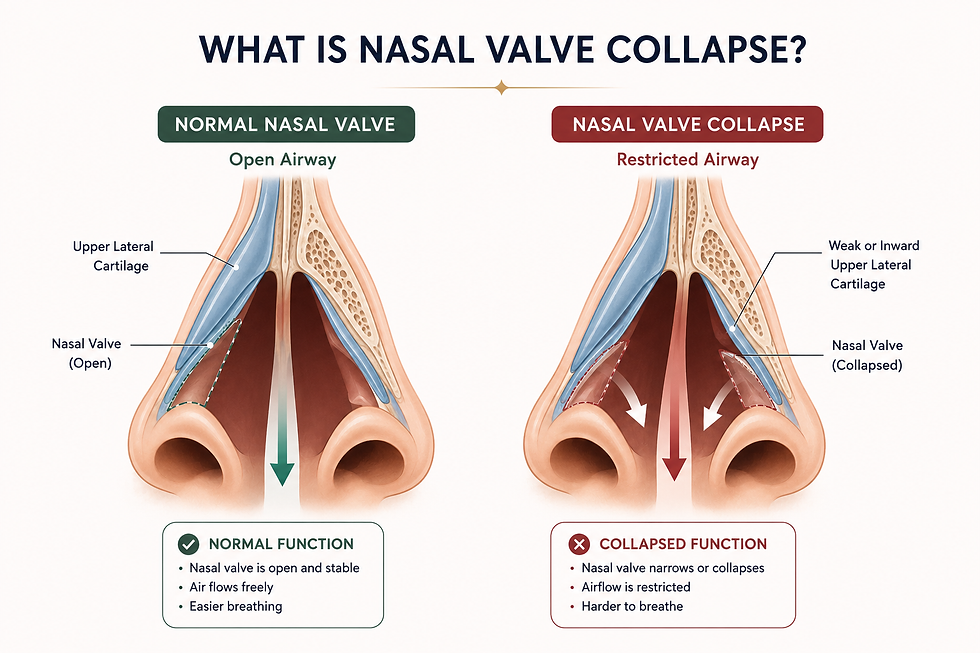
The nasal valve is the narrowest part of your entire airway — narrower than your nostrils, narrower than your sinuses. It's a small structural zone made of cartilage that controls how much air can pass through your nose with each breath.
When the cartilage supporting this area weakens — from aging, an old injury, a naturally thin nasal structure, or a previous nose surgery — it can narrow or cave inward every time you inhale. That's nasal valve collapse. It's a mechanical problem, not an inflammatory one, which is exactly why it behaves differently from a typical stuffy nose.
There are two types:
Internal nasal valve collapse — deeper inside the nose, the most common form, and the hardest to see from the outside.
External nasal valve collapse — closer to the nostril opening, sometimes visible as the nostril caving in when you breathe.
The Symptoms People Actually Describe
Nasal valve collapse rarely shows up in medical language when someone first notices it. It shows up like this:
A "clothespin" feeling — like your nostrils are being pinched shut, especially during exercise or a deep breath
One nostril visibly caves in or collapses when you inhale deeply
Nasal stuffiness that's constant, with no cold and no allergy trigger
Nasal strips (like Breathe Right) work surprisingly well — but sprays, antihistamines, and decongestants don't touch it
Breathing gets noticeably harder during exercise or lying down at night
Snoring or mouth breathing, even after ruling out a deviated septum
One-sided congestion that isn't explained by a sinus infection
If two or three of these sound familiar, it's worth reading on.

The 10-Second Self-Test: The Cottle Maneuver
There's a simple test clinicians use to check for lateral nasal wall involvement, and you can try a version of it yourself right now:
Place a fingertip on your cheek, next to your nose.
Gently pull the skin outward and slightly upward — away from your nose, not toward it.
Breathe in through your nose while holding that position.
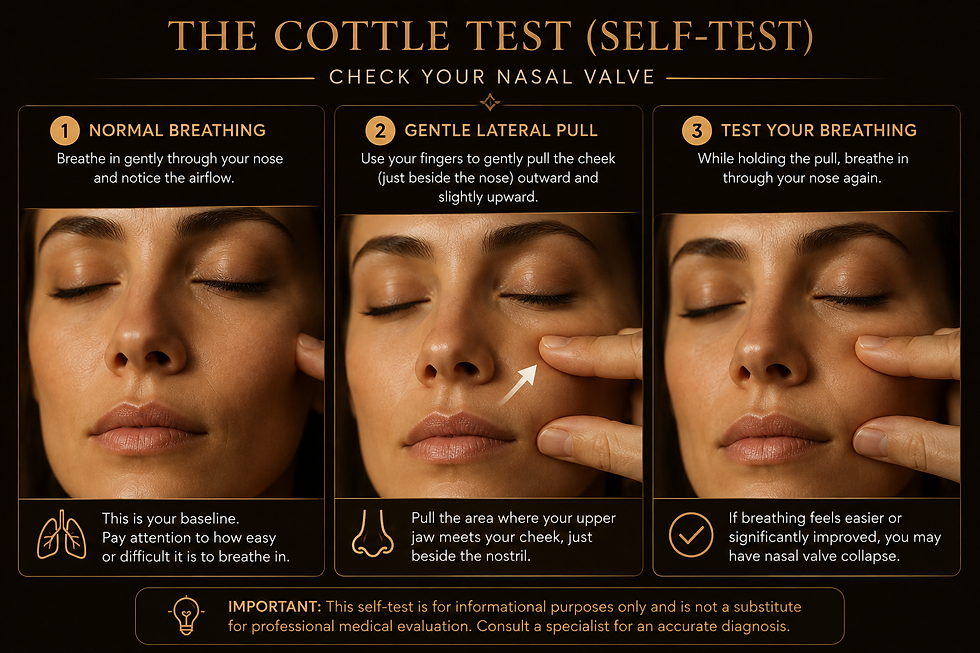
If breathing noticeably improves when you do this, nasal valve collapse is likely contributing to your obstruction. This isn't a diagnosis — only a clinical exam and endoscopy can confirm it — but it's a strong, fast signal that what you're dealing with is structural, not allergic.
Why Sprays and Allergy Medication Don't Help
This is the detail that trips up almost everyone with this condition. Steroid nasal sprays, decongestants, and antihistamines are built to reduce swelling and mucus production — they work on inflammation. Nasal valve collapse isn't inflammation. It's a cartilage wall that physically narrows or caves in with each breath.
Medication has nothing to act on. This is exactly why so many people cycle through Flonase, Afrin, and allergy pills for months — sometimes years — before anyone identifies what's actually going on.
Is This the Same as a Deviated Septum?
No — and this mix-up is common enough that it's worth spelling out clearly.
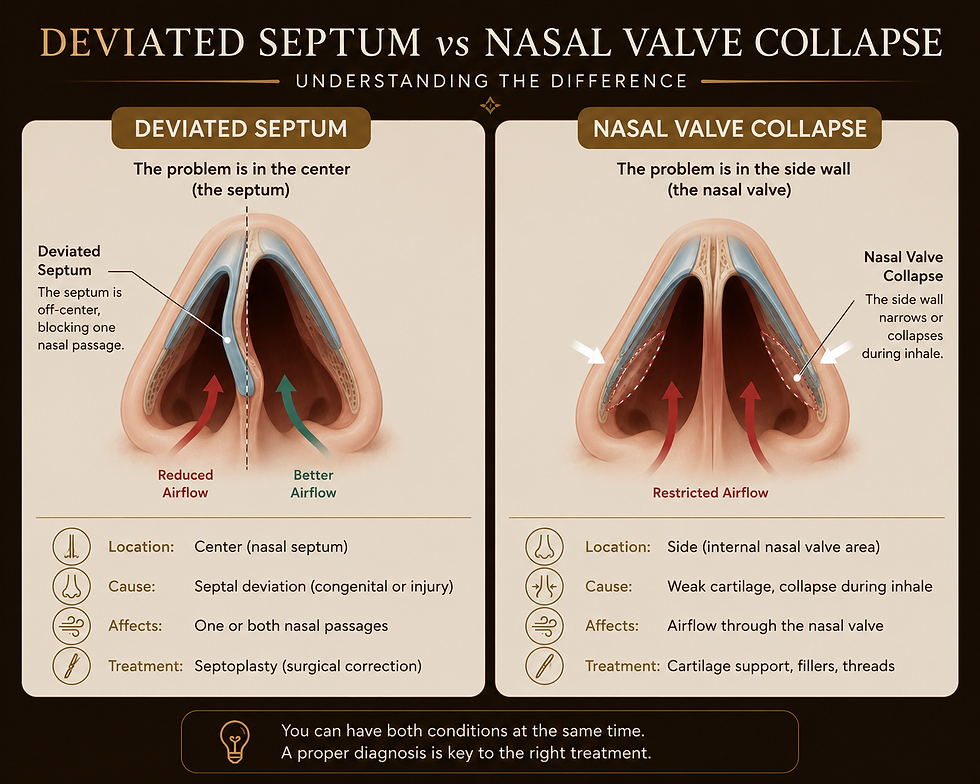
A deviated septum is a bend in the wall of cartilage that divides your two nostrils down the middle. Nasal valve collapse is a separate structure entirely — the outer sidewall of the nose, which narrows or caves inward during inhalation.
The two conditions can exist at the same time, and this overlap explains a frustrating pattern some people experience: they have septoplasty (deviated septum surgery), expect their breathing to finally improve — and it doesn't, or only partially does. If the lateral wall collapse was never addressed, the underlying problem is still there.
Treatment Options
Surgical: Cartilage grafting (such as alar batten grafts or spreader grafts) performed by an ENT surgeon can permanently reinforce the nasal wall. This involves a formal surgical procedure and recovery period.
Non-surgical, implant-based: An FDA-cleared absorbable nasal implant (marketed under the brand name LATERA®) can be placed inside the lateral wall in an office setting to mechanically support the cartilage without surgery.
Non-surgical, thread-based: Newer approaches use PDO (polydioxanone) threads placed along the lateral nasal wall to provide structural support and stimulate the body's own collagen production, without leaving a permanent device behind. This is the approach used in BreatheLift, available at Antonoff Aesthetic.
Which option makes sense depends on the severity of the collapse, your anatomy, and your own preference around surgery versus in-office procedures. This is a conversation to have with a qualified provider — not something to self-diagnose into a treatment plan.
When It's Worth Getting Checked
If the Cottle test above made a noticeable difference, or if you recognize several of the symptoms listed earlier, it's reasonable to have your nasal anatomy properly evaluated rather than continuing to manage it with medication that isn't designed for a structural problem.
Antonoff Aesthetic offers BreatheLift, a non-surgical nasal valve collapse treatment using PDO thread support, performed personally by Evgeny Antonov, PhD, MD, MSN, AGNP-C, RN, at locations in both Staten Island, NY and Boca Raton, FL.
Quick FAQ
Is nasal valve collapse common? It's more common than most people realize — studies estimate it affects up to 13% of the population, and it's a leading cause of nasal obstruction after nasal surgery.
Can I fix this without surgery? In many cases, yes. Non-surgical options — both implant-based and thread-based — are available for appropriate candidates.
How do I know for sure if I have it? A self-test like the Cottle maneuver can suggest it, but a proper diagnosis requires a clinical exam, and sometimes nasal endoscopy, from a qualified provider.
Why didn't my allergy doctor catch this? Nasal valve collapse is a structural issue, so it falls outside what allergy testing and treatment are designed to identify. It's more commonly recognized by ENT specialists or providers specifically trained in nasal anatomy.

Comments